Obedience Is a Group Project
Reflections on an underappreciated story from the book of Exodus

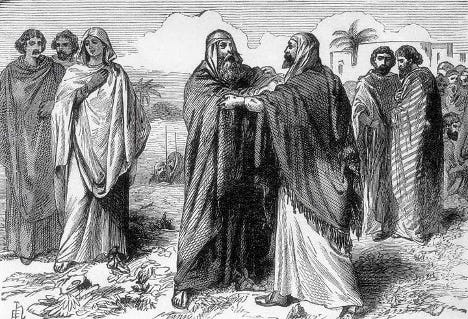
Early in the Bible is a story about a man whose father-in-law follows him to work one morning. After watching the man do his job, the father-in-law says, “You’re doing it wrong.” Then he offers helpful advice about how to do it better.
If I were to title this story, I’d call it “Area Man Survives Worst Nightmare.”
The Bible calls it “Jethro Visits Moses.”
Area Man Survives Worst Nightmare comes at an interesting point in the story arc of the book of Exodus. God hears the cries of his people in slavery and chooses Moses to lead them out of Egypt (chapters 1-4). God works a series of wonders through Moses to demonstrate his power over Egypt and its gods (5-13). Finally pharaoh turns the Israelites loose and there follow several episodes of divine provision: God protects the unarmed Israelites from pharaoh’s pursuing army by drowning them in the Red Sea (14). They write a song about it (15). God provides food in the form of birds that are easy to catch and a strange starchy side dish (“manna” means, What is it?) (16) and drinking water from a rock (17). Most of the rest of the book (19-40) is about God’s greatest provision yet: his commandments, which instruct the Israelites “the way they are to live and how they are to behave” now that they are free people.
The next three books of the Bible are likewise “law” books. Leviticus, Numbers, and Deuteronomy are all devoted to carefully articulating how God expects the Israelites to behave in relationship to him and to one another.
It’s right there between the miraculous provision of food and water and the miraculous gift of the Law that this story appears. I usually hear it referenced when Christians talk about leadership. People draw out lessons about setting priorities, delegating, empowerment. Here, it seems, God creates middle management. It’s an odd place in the story to pause for lessons in organizational leadership. I think there’s something more profound and less capitalist going on.
To this point in the story, God has been speaking his “decrees and instructions” to Moses who then speaks those decrees and instructions to the people. When there are disagreements about how to implement God’s decrees and instructions, Moses steps in to mediate. This makes Moses the bottleneck. Every communication from God to the people and every disagreement among the people has to pass through Moses. Jethro points this out: Moses can’t possibly arbitrate between all these people all the time.
As much as I dislike the idea of my father-in-law following me around the office and noting ways to improve my performance (sorry, David), Jethro is right. Moses can’t do it all by himself. And he won’t have to for long. Two innovations will make the difference. The first is that God is about to write the Law down. Once God’s word is set in stone, Moses will no longer be the only person with access to it. All the answers won’t live in his head.
The second innovation is suggested by Jethro. He recommends that Moses delegate
“able men who fear God, men of truth, those who hate dishonest gain; and you shall place these over them as leaders of thousands, of hundreds, of fifties, and of tens. Let them judge the people at all times; and let it be that every major dispute they will bring to you, but every minor dispute they themselves will judge. So it will be easier for you, and they will bear the burden with you” (v 21-23).
This system is established immediately before Moses heads up the mountain to receive a Word from the Lord. They are laying the tracks here on which the Law will run through the nation: from God to the tablets, to Moses, to the judges, to the people. For what is the “burden” the judges will share with Moses? Not leading the people, as Moses has done—out of Egypt, across the river, through the desert. Not feeding the people, as God has done with manna and quail and fresh water. The burden they will share is the job of determining how God’s instructions will apply in everyday life. It’s a task of teaching and interpreting. Moses will deliver the Word of the Lord to the people. The judges will help the people determine what the Word means for them in the mundane circumstances of real life.
There’s a lot at stake here. God promises that “if you will indeed obey My voice and keep My covenant, then you shall be My own possession among all the peoples” (19:5). The people accept these terms: “All that the Lord has spoken we will do!” (19:8). Now all that’s left to do is, you know, do it.
Reading Between the Lines
Exodus 18 tells us what it will take for Israel to obey God’s voice and keep God’s covenant. Explicitly, it’ll take a system of judges responsible for thousands, hundreds, fifties, and tens of people. Reading between the lines, this arrangement suggests (at least) three things that are true about reading and doing what God commands.
Discernment
The first is that keeping the Law will require discernment. As detailed and comprehensive as the Law is, it isn’t exhaustive. It doesn’t tell the people exactly what they should do in every situation they are certain to encounter. They agreed to do everything God expects from them before they learned what God expects from them. And God’s expectations can never be exhaustively documented in print. To keep the covenant will require the people, their judges, and Moses to exercise discernment.
That means the word of God cannot simply be heard or read. The old bumper sticker that said, “the Bible says it; I believe it; that settles it” expresses a sincere conviction but an incomplete process. Knowing what the law means for me in a particular situation requires discernment. The Bible has to be interpreted.
Disagreement
A second assumption here is that there will be disagreement. Moses’s job thus far has been to “judge between a man and his neighbor” (18:16). The people who have heartily agreed to keep God’s commands will have competing interests and conflicting perspectives. The role of the judges is not simply to inform the people about God’s commands but to arbitrate between people when there is disagreement about how they apply.
This suggests to me that differences of opinion about what the Bible means and its implications for daily life should come as no surprise, even—or especially—among people who take that Bible seriously. Everyone involved can agree that God’s word is true and binding. They may nevertheless dispute how it should be applied and enforced. It is not the peoples’ stubbornness but precisely their desire to be faithful that will cause disagreement.
Evangelicals are often terrified by disagreement. It is easily confused with other d-words, like discord or disunity. Consciously or unconsciously, we often make belonging dependent on shared opinion. Exodus 18 suggests that God’s people can be one in spirit and of the same mind without being of the same opinion in all matters.
Dialogue
The need to use discernment inevitably will result in disagreement. That’s why there must also be dialogue.
Judges are appointed as leaders over groups of varying size—groups of tens, fifties, hundreds, and thousands. I suspect these numbers have less to do with competency and more to do with how the nation was organized. Israel’s social units were families (tens), which together made up clans (fifties), which together made up tribes (hundreds), which collectively made up the nation (thousands). Discernment is exercised through dialogue at every level of society.
Obedience is a group activity. One person alone with the Law is a recipe for misinterpretation, or at least myopia. What’s needed is a community with equal stake but conflicting interests and different opinions discerning together what God expects from them in their time and place.
Grace After Grace
There’s an interesting pattern in the creation account in Genesis. God creates the environments in which things will live (skies, waters, dry ground) before he creates the things that live in them (birds of the air, fish of the sea, beasts of the field.) That pattern echoes here. Before God gives his people his instructions, he creates the environment in which those instructions can flourish. Before he creates a text, he creates a community of interpretation.
This is one more grace in a series of several. And it tells us something about God’s character. He always liberates before he legislates. Salvation from Egypt comes before any expectation of obedience. And then before he legislates, he establishes conditions under which obedience is possible.
There’s another grace here, between the lines perhaps, which gives me comfort. The fact that faithfully reading and doing God’s word requires discernment and assumes disagreement and is achieved through dialogue suggests that God also extends the grace to be wrong. Faithfulness isn’t measured like a batting average. It is demonstrated by participating in the process described above. That’s good news, because neither of us is as right as we think we are.